US road rules
Can you go through a yellow light?
Yes, if you cannot stop safely. A yellow light warns you that the light is about to turn red. If you can stop safely before the line, stop; if you are too close, go through with caution. In California and many other states, entering on yellow is legal and you may still be in the intersection when it turns red: the offense is crossing the line after it is red.
The rule
- A steady yellow means the green is ending and red comes next. It is a warning, not a dare.
- If you can stop safely before the stop line, or before the crosswalk if there is no line, stop.
- If you are too close to stop without slamming the brakes, go through carefully. Do not speed up to beat it.
- Already in the intersection when it turns yellow or red? Keep going and clear it. Stopping in the middle blocks everyone.
- A yellow arrow means your protected turn is ending. A flashing yellow means slow down and go with care; a flashing yellow arrow means you may turn, but you yield to oncoming traffic.
Where drivers get it wrong
- Speeding up to beat it. Yellow is timed for drivers who cannot stop, not a signal to hurry. Racing it is how a yellow becomes a red at the line.
- Slamming on the brakes. Stopping hard from right at the line risks the car behind you. Too close to stop safely means go.
- Stopping in the box. If you entered legally, finish the move. Freezing in the middle of the intersection on red is its own mistake.
Is running a yellow light illegal?
In California, the yellow itself only warns you: Vehicle Code §21452 says red is coming and nothing more. The red rule, §21453, applies at the limit line, so a car that crossed the line on yellow has not run the red, even if the light changes while it is in the intersection. Texas words its law the same way, and New York's says outright that traffic facing a steady yellow "may enter the intersection".
Some states go further. In Oregon, a driver facing a yellow "shall stop" at the line, and may drive through only if they cannot stop in safety. Virginia says traffic not yet in the intersection must stop if it is not reasonably safe to continue. So in some places, going through a yellow you could easily have stopped for can get you a ticket.
Everywhere, the safe habit is the same: stop if you can do it calmly, go if you cannot. California's handbook says exactly that, and examiners on a road test expect it.
How long is a yellow light?
Engineers set it from the speed of the road, so faster roads get longer yellows. Federal guidance has long suggested 3 to 6 seconds, timed so that a driver at the limit has room either to stop comfortably or to clear the line before red.
How Yield tests it
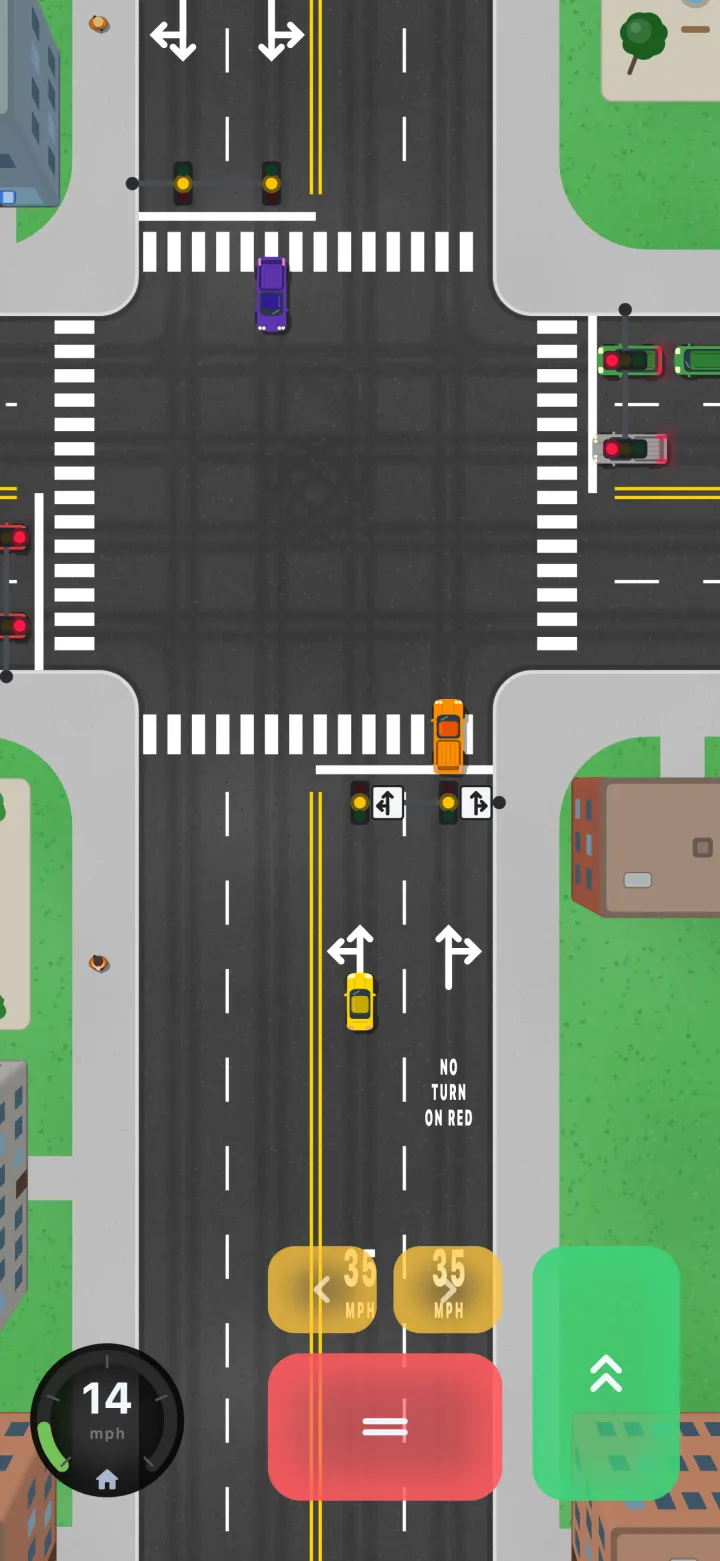
Yield's multi-lane lights judge the yellow the way the light was timed. The moment it changes, the game checks whether you had room for a calm stop: a second to react, then gentle braking. If you did and drove in anyway, that is Ran a yellow you could stop for. Too close to stop is not a fault, and neither is pulling away when you were already waiting at the line. Reach the intersection after it turns red and it is Ran a red light.
- Ran a yellow you could stop for
- Ran a red light

Yellow is not "hurry". If you can stop without standing on the brakes, stopping is the call.
Ray, your instructor in Yield
Rules differ from state to state, and where they do, your state's driver handbook is the one that counts. Yield is practice, not driver's ed or legal advice. Sources: California Driver Handbook: Laws and Rules of the Road; California Vehicle Code §21452 (yellow signal); California Vehicle Code §21453 (red signal); New York Vehicle and Traffic Law §1111; Oregon ORS 811.260; Virginia Code §46.2-833; FHWA MUTCD (2009) §4D.26: yellow change intervals.