
US road rules
How do speed limits work?
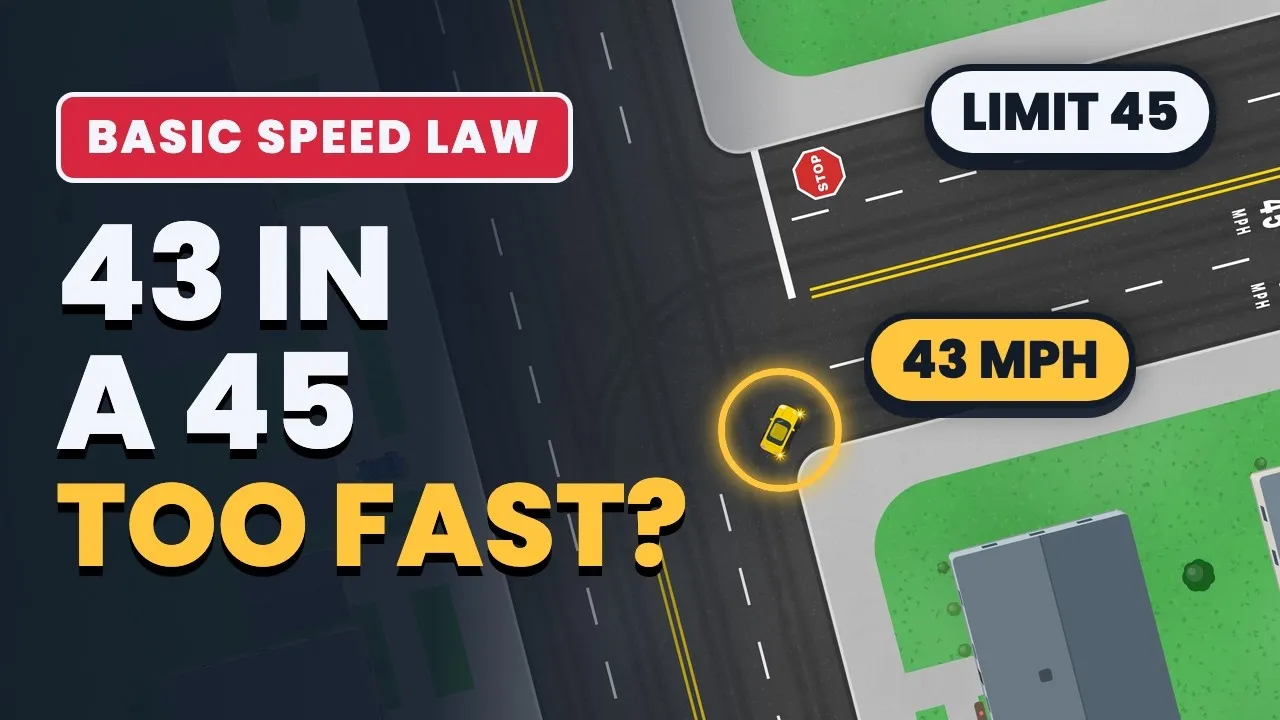
The posted limit is the most you may drive in good conditions, not a target. Every state also requires you to slow down for conditions, often called the basic speed law: never faster than is safe for the traffic, weather and visibility, even below the limit. Where no limit is posted, state law sets one; in California, business and residential streets default to 25 mph.

Watch it: 3 min
The rule
- Posted limits are maximums for ideal conditions.
- The basic speed law applies even under the limit: in rain, fog, heavy traffic or near children, the safe speed is lower than the sign.
- Unposted streets have default limits set by state law. California's is 25 mph in business and residential districts; other states set their own.
- Work zones carry lower limits and, in many states, doubled fines.
- A new street can mean a new limit. Watch for the change, especially leaving a fast road for a side street.
Where drivers get it wrong
- Going with the flow. Matching faster traffic does not make it legal, and it is no defense on a road test.
- Missing the change. The limit drops the moment you turn into a residential street, not a block later.
- Speeding up in the work zone. An empty-looking work zone still has its limit, and the fine is often doubled.
Does every state have a basic speed law?
In substance, yes. 44 states and DC use some form of the same sentence: no driving faster than is reasonable and prudent for the conditions. California's version is §22350. Six states word it differently but reach the same place: Tennessee requires a safe speed notwithstanding any limit, and Missouri, Mississippi, New Jersey and New Mexico do it through careful-driving and reduce-speed-for-hazards rules. In Virginia, driving too fast for conditions is reckless driving, a criminal misdemeanor, "regardless of any posted speed limit."
Nowhere is the posted limit a safe harbor. Driving at it in fog or heavy rain can still get you a ticket.
Is going over the limit always a ticket?
In most states, and in DC, yes: the posted number is absolute, and going over it is the violation by itself. A few states make some or all limits prima facie: going over is presumed unsafe, and you can argue the speed was safe for the conditions. Texas and Utah work this way for nearly every limit, and so do Massachusetts and Rhode Island.
California is mixed. Its 25 mph street defaults and posted zone limits are prima facie, but the 65 mph highway maximum (55 on two-lane undivided roads) and the 70 mph freeway maximum are absolute. Prima facie still means you get the ticket; it only lets you argue it later. On a road test, over the limit is over the limit.
How Yield tests it
Every street in Yield has its own limit, 25 to 45 mph depending on the road, and it is painted in your lane at the start of each one. Hold more than the limit for longer than a second and a half and it is Exceeded the speed limit. Work zones have their own lower limit.
- Exceeded the speed limit
- Sped through a work zone

The posted limit is a ceiling, not a target. Check the number painted at the start of each road.
Ray, your instructor in Yield
Rules differ from state to state, and where they do, your state's driver handbook is the one that counts. Yield is practice, not driver's ed or legal advice. Sources: California Vehicle Code §22350 (Basic Speed Law); California Vehicle Code §22352 (prima facie limits); California Vehicle Code §22351 (prima facie speeding); Texas Transportation Code §545.352; Virginia Code §46.2-861.