US road rules
What does a DO NOT ENTER sign mean?
It means the road, ramp or driveway past the sign is closed to you from where you are, usually because its traffic is coming toward you: a one-way street, a freeway exit ramp or one side of a divided road. Do not pass it; turn the other way. If you go in by mistake and see a WRONG WAY sign, pull over as far right as you can, and when it is safe, back out or turn around.
The rule
- DO NOT ENTER, a red circle with a white bar, stands where you could drive into a one-way street, a freeway exit ramp or a divided road the wrong way. It faces the drivers who might turn in.
- WRONG WAY, a red rectangle, is posted farther along the same road as a second warning. If you can read it, you are already going against traffic.
- Gone in by mistake? Slow down and get as far right as you can. California's handbook says it plainly: when it is safe, back out or turn around.
- At night, road reflectors that shine red in your headlights mean you are going the wrong way.
- A black-and-white ONE WAY arrow at the corner shows which way the cross street runs. Turn only the way it points.
Where drivers get it wrong
- Driving on to the next corner. Carrying on a block against traffic to reach a turn is the dangerous choice. Pull to the side and turn around as soon as it is clear.
- Turning around on a highway. On a freeway or ramp, do not try a U-turn across traffic. Get onto the shoulder, put the hazard lights on, and call 911 for help getting off.
- Missing the sign at a turn. DO NOT ENTER signs stand at the corner you would turn in at. Look for one, and for a ONE WAY arrow, before every turn onto a street you do not know.
One-way street rules
On a one-way street, every lane goes your way, so the lanes are split by white lines. In California you may pass on the right on a one-way street, and you may never make a U-turn on one.
Turning right from one one-way street onto another, start in the far-right lane; if it is safe, you may end the turn in any lane. At a T-intersection where a one-way street meets a two-way street, traffic going straight has the right-of-way, and you may turn either right or left from the center lane.
Left turns out of a one-way street, and left on red from one one-way street onto another, have their own rules: see unprotected left turns.
What if you are going the wrong way on a highway?
Pull over right away, onto the shoulder or as far right as you can, and turn on your hazard lights. On a highway, Colorado State Patrol says to call 911 for help getting off safely; on a smaller street, turn around when it is safe.
Federal sign rules put DO NOT ENTER and WRONG WAY signs at the foot of freeway exit ramps, facing the crossroad, because that is where a wrong turn takes you onto the freeway against traffic.
How Yield tests it
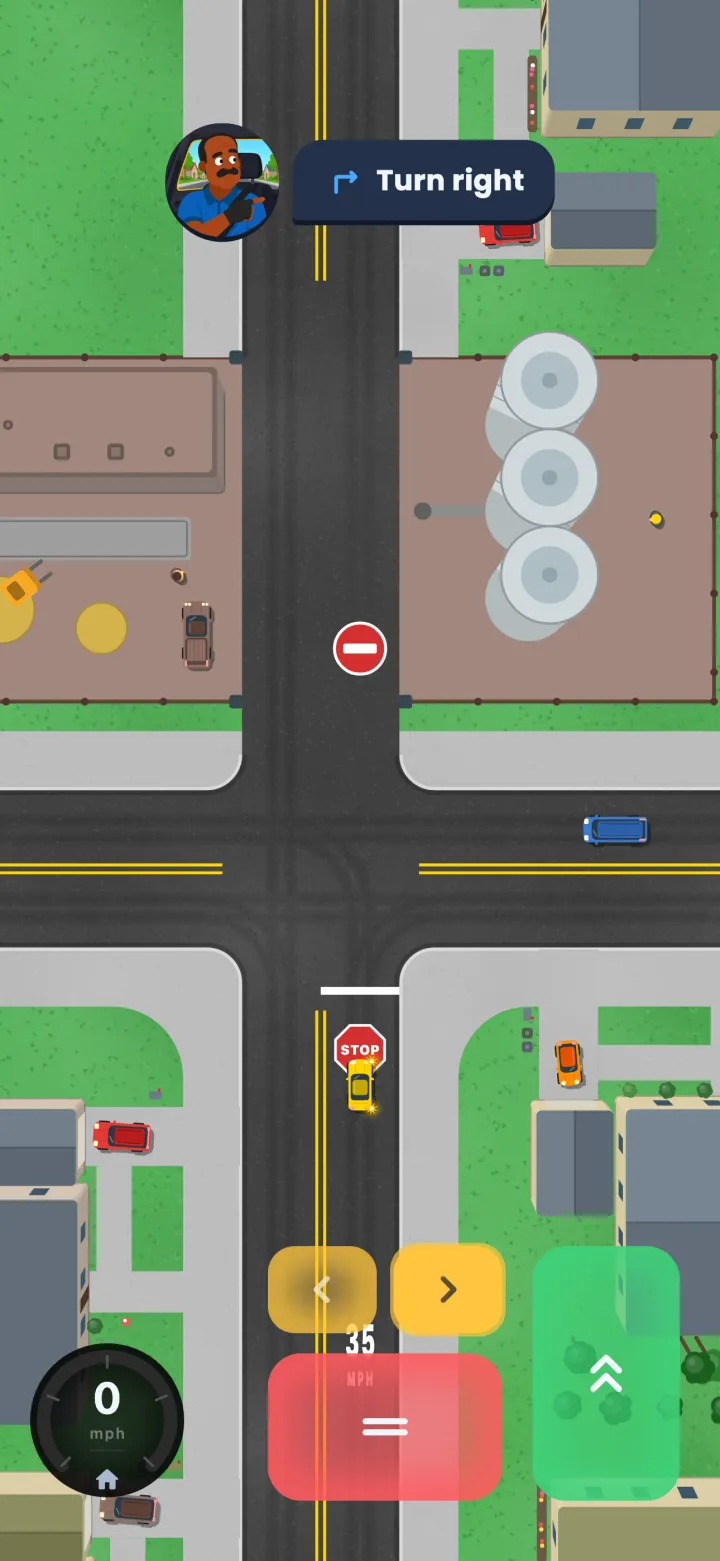
Every T-junction in Yield ends at a gate: straight ahead is a private road into a factory, a parking lot or a farm yard, with a DO NOT ENTER sign facing you across the junction. Ray always calls a left or a right there. Roll straight on, and the moment your nose crosses the gate line it is Ignored a DO NOT ENTER sign. Take the wrong turn instead, and it is Missed your turn.
- Ignored a DO NOT ENTER sign
- Missed your turn
DO NOT ENTER means that road is not yours. If you missed your turn, keep going and come back around.
Ray, your instructor in Yield
Rules differ from state to state, and where they do, your state's driver handbook is the one that counts. Yield is practice, not driver's ed or legal advice. Sources: California Driver Handbook: Laws and Rules of the Road; California Driver Handbook: Navigating the Roads; California Vehicle Code §21657 (one-way roadways); California Vehicle Code §21461 (obey regulatory signs); FHWA MUTCD 11th Edition, Chapter 2B: Regulatory Signs; FOX31 Denver: Colorado State Patrol wrong-way driving tips.